The AI Tools Revolution is transforming how individuals, businesses, and industries operate. From content creation to automation, data analysis to customer service, AI tools are reshaping digital productivity and redefining efficiency. In today’s competitive world, leveraging AI tools is no longer optional—it is essential for growth and innovation.
This comprehensive guide explores the impact of the AI Tools Revolution, highlighting powerful AI platforms, practical applications, benefits, challenges, and future trends.
What Is the AI Tools Revolution?
The AI Tools Revolution refers to the rapid development and adoption of artificial intelligence tools designed to automate tasks, enhance creativity, and improve decision-making. These tools use machine learning, natural language processing, computer vision, and predictive analytics to perform tasks that once required human intelligence.
Unlike traditional software, AI tools continuously learn from data. This adaptability allows businesses to optimize workflows, personalize experiences, and improve operational efficiency.
The AI Tools Revolution is not just about technology—it is about smarter systems that work alongside humans to maximize productivity.
Why the AI Tools Revolution Matters
The AI Tools Revolution is changing industries in five major ways:
- Automation of repetitive tasks
- Enhanced creativity and content generation
- Data-driven decision-making
- Improved customer experiences
- Faster innovation cycles
Organizations that embrace AI tools gain competitive advantages by saving time, reducing errors, and scaling operations efficiently.
Categories of AI Tools Transforming Industries
1. AI Content Creation Tools
Content creation has been completely reshaped by the AI Tools Revolution. AI-powered writing assistants generate blogs, product descriptions, emails, and marketing copy in seconds.
Popular AI content tools help with:
- SEO optimization
- Grammar correction
- Content ideation
- Social media captions
- Script writing
These tools improve productivity while maintaining quality and consistency.
2. AI Image and Design Tools
Design is no longer limited to professionals. AI image generators and editing tools allow users to create visuals, logos, and graphics effortlessly.
The AI Tools Revolution in design includes:
- Text-to-image generation
- Background removal
- AI-based branding design
- Automated video editing
- Animation creation
This democratization of design empowers small businesses and creators.
3. AI Coding and Development Tools
Software development has become more efficient due to AI coding assistants. These tools suggest code, debug errors, and generate entire functions.
Benefits include:
- Faster development cycles
- Reduced bugs
- Automated documentation
- Smart code completion
The AI Tools Revolution is accelerating innovation in software engineering.
4. AI Automation Tools for Business
AI automation tools streamline business operations by managing repetitive tasks such as:
- Email automation
- Customer support chatbots
- Data entry
- Inventory management
- Workflow automation
Through the AI Tools Revolution, businesses reduce operational costs while improving accuracy.
5. AI Data Analytics Tools
Data is the backbone of modern business. AI-powered analytics tools analyze massive datasets to uncover patterns, predict trends, and generate actionable insights.
These tools help with:
- Predictive forecasting
- Customer behavior analysis
- Risk assessment
- Performance tracking
The AI Tools Revolution enables smarter, faster decision-making.
Key Benefits of the AI Tools Revolution
Increased Productivity
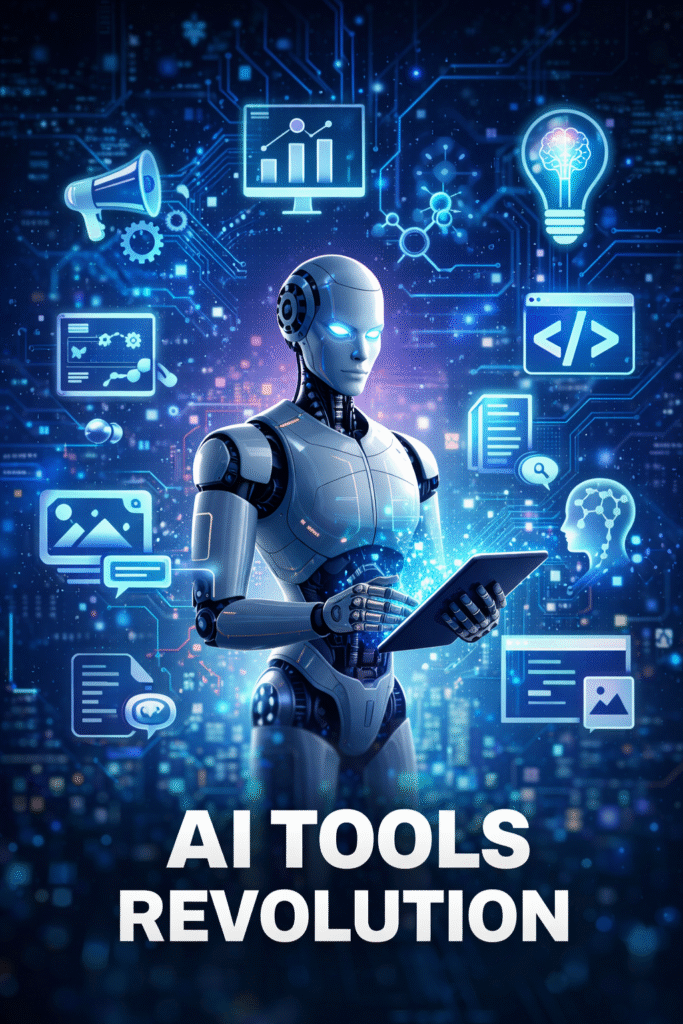
AI tools automate repetitive tasks, allowing teams to focus on strategic and creative activities.
Cost Efficiency
Businesses save money by reducing manual labor and minimizing errors.
Improved Accuracy
AI systems process data with precision, reducing human mistakes.
Scalability
AI tools allow companies to scale operations without proportionally increasing workforce size.
Personalization
The AI Tools Revolution enables personalized marketing, recommendations, and customer engagement.
AI Tools Revolution in Different Industries
Healthcare
AI tools assist in:
- Medical diagnosis
- Drug discovery
- Patient monitoring
- Predictive analytics
Healthcare innovation has accelerated due to intelligent systems.
Education
AI tools personalize learning experiences through:
- Adaptive learning platforms
- Automated grading
- AI tutoring systems
- Content recommendations
The AI Tools Revolution is making education more accessible and customized.
Marketing
Marketing has been transformed through:
- AI-driven SEO tools
- Audience segmentation
- Predictive analytics
- Campaign optimization
Marketers leverage AI tools to maximize ROI and engagement.
Finance
In finance, AI tools are used for:
- Fraud detection
- Algorithmic trading
- Risk management
- Credit scoring
The AI Tools Revolution increases security and efficiency in financial systems.
Generative AI: The Core of the AI Tools Revolution
Generative AI plays a central role in the AI Tools Revolution. It creates:
- Text
- Images
- Videos
- Code
- Music
Generative AI models learn patterns from vast datasets and generate original outputs. This technology is redefining creativity and productivity across industries.
Challenges in the AI Tools Revolution
Despite its advantages, the AI Tools Revolution presents challenges:
Data Privacy Concerns
AI tools require large datasets, raising privacy and security concerns.
Ethical Issues
Bias in AI algorithms can lead to unfair outcomes.
Job Displacement Fears
Automation may replace certain job roles, though it also creates new opportunities.
Overdependence on Automation
Excessive reliance on AI tools can reduce critical thinking skills.
Addressing these challenges ensures responsible AI adoption.
How to Choose the Right AI Tools
When adopting AI tools, consider:
- Business goals
- Ease of integration
- Data security
- Scalability
- Cost-effectiveness
The AI Tools Revolution offers numerous options, but strategic selection is essential.
Future Trends in the AI Tools Revolution
The next phase of the AI Tools Revolution includes:
- AI-powered virtual assistants
- Hyper-personalized digital experiences
- Autonomous business systems
- AI-human collaboration platforms
- Advanced generative AI models
As AI continues evolving, intelligent automation will become more seamless and integrated into daily life.
Practical Steps to Embrace the AI Tools Revolution
- Identify repetitive tasks suitable for automation
- Train teams to use AI platforms
- Start with small pilot projects
- Monitor performance metrics
- Scale gradually
The AI Tools Revolution rewards early adopters who innovate strategically.
AI Tools Revolution and Digital Transformation
Digital transformation strategies increasingly rely on AI tools. Companies that integrate artificial intelligence into core operations achieve:
- Greater operational agility
- Real-time analytics
- Improved customer insights
- Sustainable growth
The AI Tools Revolution is not a temporary trend—it is the foundation of future digital ecosystems.
Conclusion: The Era of Intelligent Innovation
The AI Tools Revolution represents a powerful shift in how technology supports human potential. From automation to creativity, analytics to personalization, AI tools are reshaping the digital landscape.
Businesses that embrace the AI Tools Revolution gain competitive advantages, improve efficiency, and unlock new opportunities for growth. As artificial intelligence continues advancing, its role in daily life and industry will only expand.
The future belongs to those who understand, adapt, and innovate through AI-powered systems.